An Inside Look at Beech Leaf Disease
A new study led by a team of scientists from the Yale School of the Environment found differences at the cellular level of leaves from infected Beech trees — variations that may account for tree mortality.
Did you know that alert community members are the first to spot most invasive insect infestations? The Forest Pest First Detectors (FPFD) program trains volunteers to protect our forests. If you care about preserving our natural heritage, this free, on-line training is for you!
When you are in your sugarbush this winter, be on the lookout for signs of Asian longhorned beetle (ALB).
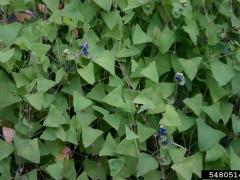
Mile-a-minute weed (MAM, Persicaria perfoliata), a highly invasive plant, has been confirmed for the first time in Vermont.
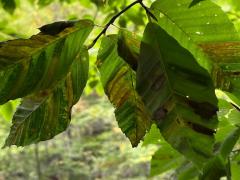
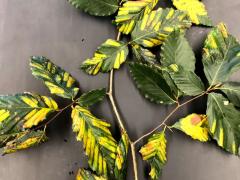
Beech leaf disease (BLD), caused by the invasive nematode or roundworm Litylenchus crenatae mccannii, has been confirmed for the first time in Vermont.
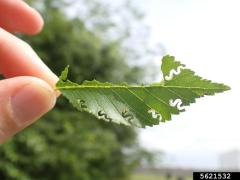
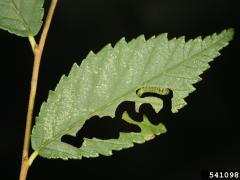
The invasive insect known as Elm zigzag sawfly (EZS) has been confirmed for the first time in Vermont. After receiving a report of potential EZS activity in northwestern Vermont, staff from both the Forest Health program of the Department of Forests, Parks, and Recreation (FPR) and Plant Health program of the Agency of Agriculture, Food, and Markets (AAFM), collected larval samples from affected elm foliage in May 2023. Samples were sent to the US Department of Agriculture Plant Protection and Quarantine program for identification, and EZS has now been officially confirmed within the state.
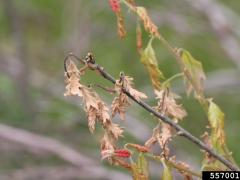
Public reports and staff observations recorded damages across the state from Highgate to Halifax, with cold pockets and river valleys seeing the most extensive damage. Most reports of freeze damage in forests stated damage to members of the Fagaceae family, including American beech (Fagus grandifolia) and red oak (Quercus rubra) regardless of geographic location.
Vermont Woodlands Association is partnering with the Vermont Department of Forests, Parks and Recreation to gather more information about the geographic extent of the damage as well as the species involved.
Vermont’s Noxious Weeds Quarantine rule was adopted in 2002, and most recently amended in 2012, and is implemented by the Agency of Agriculture, Food and Markets under its statutory authority. The rule regulates the importation, movement, sale, possession, cultivation, and/or distribution of certain plants known to adversely impact the economy, environment, or human or animal health.